
Culture & Leadership
An Island That Can Fill Fifth Avenue and Cannot Fill a Glass
This past weekend the Puerto Rican flag moved up Fifth Avenue by the thousands. The NYC Puerto Rican Day Parade is one of the proudest sights the diaspora owns, generations deep, loud with music and a belonging you can feel from a block away. At that same hour, a few thousand miles south, the island all those flags belong to could not turn on a faucet.
Laura Camila Rivera · June 16, 2026
This past weekend the Puerto Rican flag moved up Fifth Avenue by the thousands. The NYC Puerto Rican Day Parade is one of the proudest sights the diaspora owns, generations deep, loud with music and a belonging you can feel from a block away. At that same hour, a few thousand miles south, the island all those flags belong to could not turn on a faucet.
The same weekend, a therapist in our community posted the list of towns that had no water while the floats rolled, San Juan, Caguas, Bayamón, Guaynabo, Gurabo, Juncos, with no real return date past the middle of the week if that. She asked the question I keep hearing in different words from everyone: how does an island end up unable to give its own people water. Her answer was blunt, that the government has failed to fix the infrastructure while moving quickly to approve luxury development that draws from the same strained system.
On June 1, as hurricane season opened, the government declared itself ready. The team who runs the Aqueduct and Sewer Authority, la AAA, pointed to more than fifteen hundred generators staged at filtration plants, far more than the few hundred the island had in 2017, as proof that if the grid failed, the water would keep running. Within days, however, roughly forty thousand customers across the metro region and the north were facing interruptions, tens of thousands had no service at all, and the agency could not say when it would come back. We are well in the hundreds of thousands now. The historian Israel Meléndez Ayala, who has tracked this closely, named the contradiction plainly: the government readied itself for the disaster it pictures, a storm, a blackout, something temporary, and ignored the one already sitting in people's homes. We were told the island was ready for the hurricane, and it could not give us water before the hurricane arrived.
This did not begin the weekend it made the news
Parts of San Juan have reported intermittent service for more than a year, with the governor herself acknowledging the system has gone without real investment or maintenance for decades. By June 5, sectors of Loíza including Piñones had gone thirteen days sin agua, and the mayor there was weighing whether to join San Juan's lawsuit. Café Regina, on Calle Loíza, turned its Instagram into a public ledger of the failure, counting the days out loud until it passed 45 days running on rooftop cisterns it spent fifty-five hundred dollars to install and close to a thousand dollars a week to keep filled. The mayor of San Juan sued the water authority in late May, and a judge had to order the agency to hand over its own basic operating data, tank levels, pump histories, maintenance records, because a public utility would not share it otherwise.
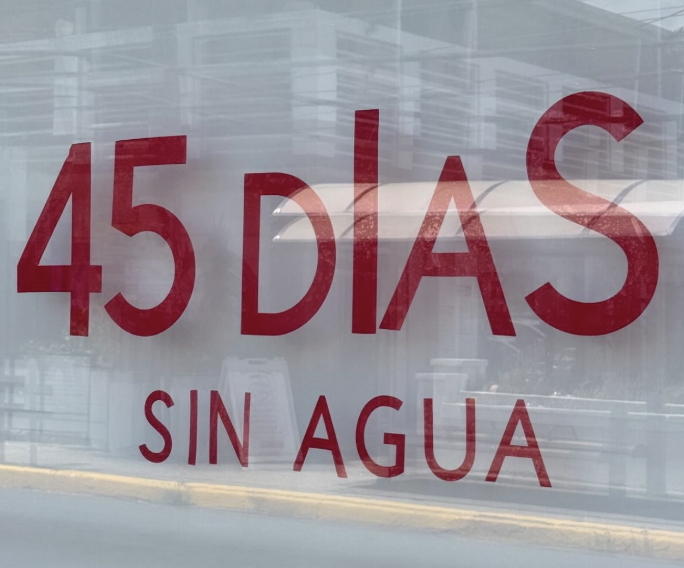
The Window Pane at Café Regina on Calle Loíza, San Juan
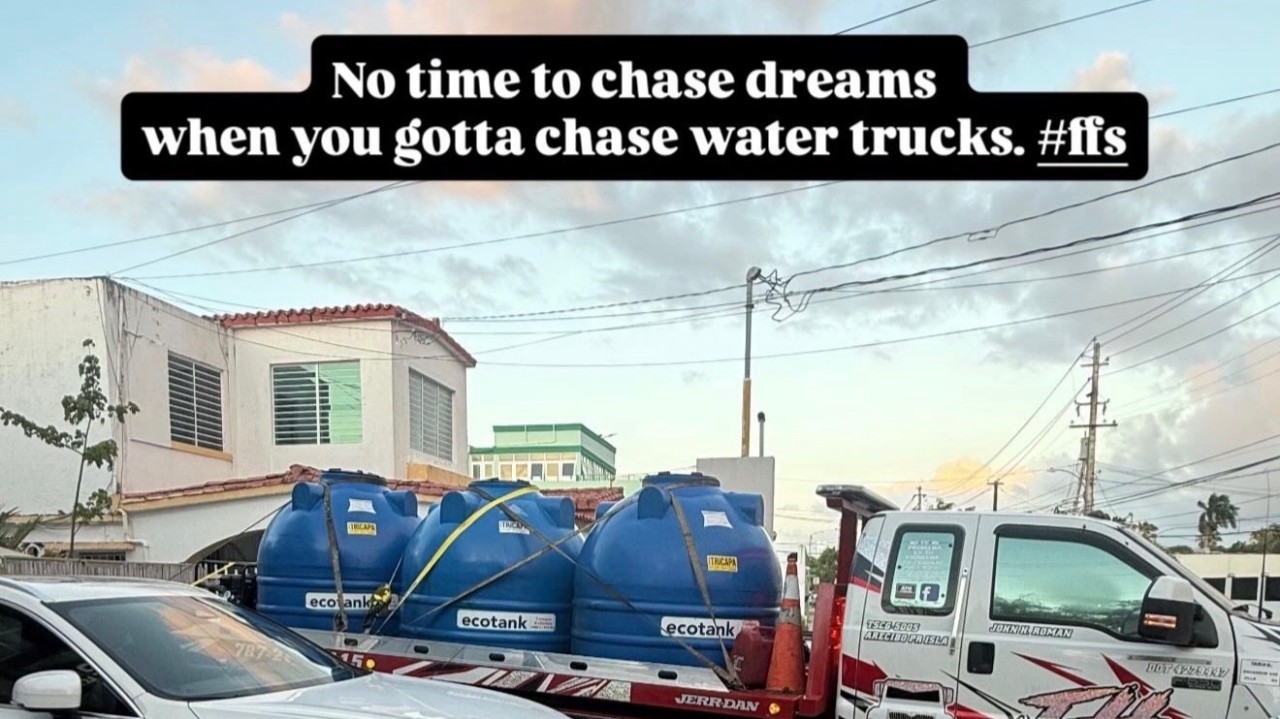
A founder I know posted a photo to his stories of a flatbed tow truck hauling three giant water cisterns down a residential street at dusk, captioned, no time to chase dreams when you gotta chase water trucks. The island is not asking its builders for their best ideas right now. It is asking for their evenings, spent calling relentlessly for the emergency response to help you and ending up having to flag down a truck around the block and pay by the gallon to keep water in the house.
What people are living and what the official channels say have stopped lining up. The agency tells residents the service will come back "gradually." A restaurant cannot make payroll gradually. A mother cannot feed three kids on a promise that the pressure might return whenever the system stabilizes. On June 8, González Delgado said the crisis would be solved by the end of 2026 and insisted the problem was infrastructure, not management. Any clarity helps, but as I sit with that timeline I can't help but think that if the official plan is to fix it by the end of the year, the official plan is also that families spend the rest of the year hauling buckets. The Fiscal Oversight Board has warned the agency is patching its budget with reserves that could run dry within a year, while the system loses close to sixty-five percent of the water it produces before it ever reaches a home.
The words coming from people on the ground are not careful, and they should not have to be. A community leader in Santurce called it inhuman and said it is wrecking people emotionally. A sixty-one-year-old organizer who phones the emergency office every other day to beg for a truck said plainly that no one should have to live like this. A seventy-nine-year-old woman in public housing hurt her back carrying buckets, then her husband hurt his doing the same, and she cried while she described it. You can read the priorities in who got served first. Somehow, we ran dedicated water trucks to keep hotels and short-term rentals supplied while the agriculture department had to sanitize milk trucks to carry drinking water to the rest of us.
And the hardest part of all of this is that no one can tell you what is actually true. The AAA corporation says one thing, the government representatives say another, the timelines shift by the hour, and the only reliable information most of us get comes from a neighbor's text at dawn saying whether they have water, a trickle, or nothing. When the people living it and the people in charge are describing two different realities, the communication channels meant to keep us safe are not just strained, they are failing all of us. You end up rationing trust the same way you ration water.
I am writing this from an apartment that has not had running water in weeks
It was already starting when I left for a stretch of work on the mainland, and I came home two weeks later to find it worse, not better. I have to shower at the gym. I wash dishes with rainwater I catch in rain barrels on my terrace. There is a woman in my building who is not from here, and every day her messages in our group chat get a little more frightening and alarming, because she does not have the muscle memory the rest of us built growing up here. And here is what unsettles me most. Los que somos de aquí are shaken too. We are supposed to be hardened to this. We are not. You do not get used to a government that treats water like a luxury.
I am also aware of how much room I have to even write this. I have community. I still have power while others don't. I have a gym membership at a place that has a cistern. I was able to go buy more socks when I ran out of clean laundry. I have work that lets a catastrophe land on me as an inconvenience instead of an emergency. On an island where more than forty percent of people live below the poverty line, most of my neighbors have none of that cushion, and they are tired in a way that runs deeper than the body, worn down from fighting uphill for something that should simply exist.
Last week I opened the Diaspora Summit, the anchor of an initiative we are calling El Momento, a day where ALPFA Puerto Rico , PRIIN: Puerto Rico Impact Investment Network , and a room full of partners sat with the real question of what it takes to invest in this island instead of mourning it. I told that room the same thing I am telling you, that I was speaking to them from an apartment with no water, from the real Puerto Rico and not a polished idea of it. Afterward someone came up to me and asked how I keep showing up to the work when the island keeps breaking like this. The honest answer has two parts: One is hope, real hope, the kind that fills Popular Center PH and a parade route in the same week, the kind that gets people to put their time and their skill and their money behind this place from wherever in the world they are. That is the whole reason El Momento exists, to give that hope somewhere real to land.
The other part is that we do not have a choice
No one is coming to fix this for us, not from far away and not in time, and the work stops being optional when it is the only thing standing between our people and the next failure. That has been a running theme for me since I heard it (admittedly) on TikTok the other day: no one is coming to save us, but that also means no one is coming to stop us.
I will say something I do not usually say out loud. My own will is not enough to carry me anymore. Some mornings the personal drive is just gone. What moves me on those days is the mission, the fact that the work matters to people who are counting on it, and the mission carries me when I cannot carry myself. That is not giving up. But I am not going to dress it up as anything cleaner than it is.
So I am asking for one thing, mi gente, look at this. Pay attention. Not the filtered version. The real one: An island that can fill Fifth Avenue and cannot fill a glass.
I am tired. Pero I am still here.
Y seguimos 🇵🇷
Sources
Dánica Coto, "Once beset by power outages, Puerto Ricans also hit with severe water shortages," Associated Press via ABC News, June 12, 2026.
Israel Meléndez Ayala, "Water Is Puerto Rico's New Crisis," Crítica, June 10, 2026.
"Superaqueduct break: what to know about possible water outage for 100,000+ in Puerto Rico," El Nuevo Día, June 11, 2026.
Originally published on LinkedIn on 2026-06-16.